
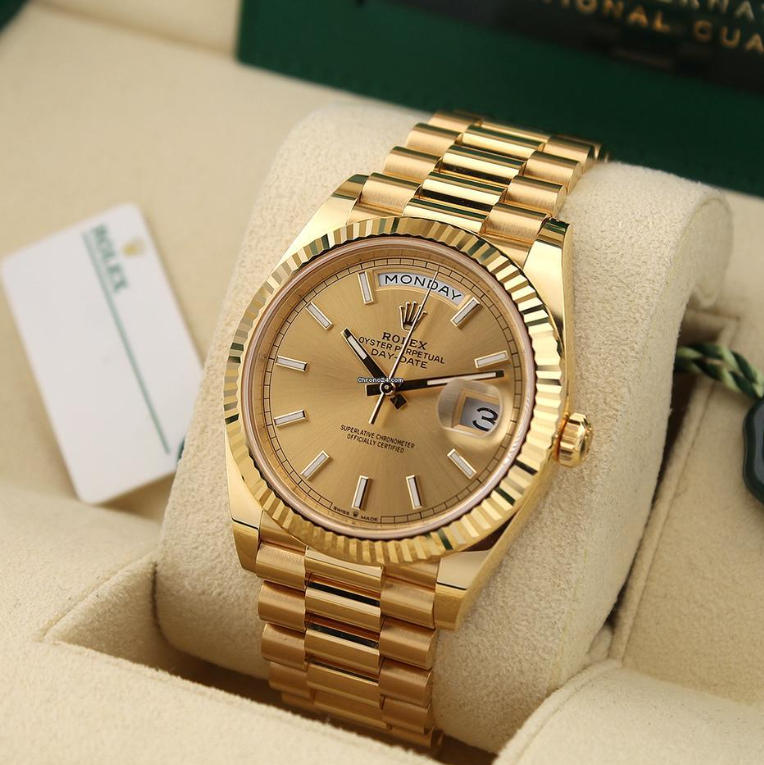
There are Rolex watches that became famous because of a particular sport or profession, and then there is the Day-Date. It never needed a diving depth rating, racing connection or aviation story to establish its identity. The watch became recognisable because Rolex kept its basic idea remarkably clear: precious metal, a date at three o’clock, the day written in full across the top of the dial and, eventually, the bracelet most people now know as the President.That simplicity is also why the Day-Date remains interesting when looking at the modern replica market. A complicated-looking watch can sometimes distract the eye with extra sub-dials or scales. A Day-Date does the opposite. With relatively few elements on the dial, every proportion becomes easier to notice.For readers using ZZZX to follow Rolex replica watches in the UK, the Day-Date is a useful model to study because it shows how much of a watch’s character comes from proportion, finishing and small details rather than headline specifications.
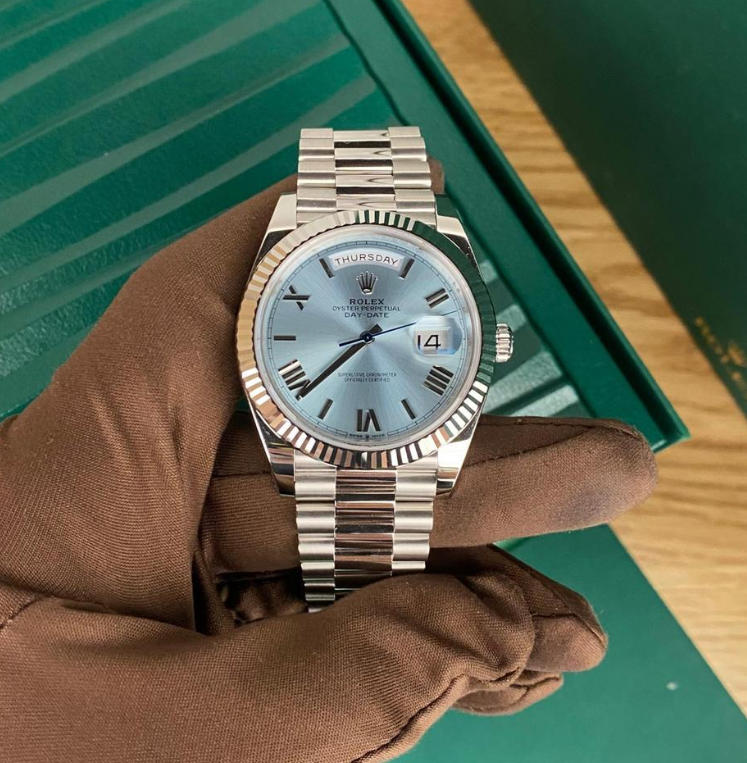
The Day-Date Has Always Had a Different Place in Rolex
Rolex introduced the Oyster Perpetual Day-Date in 1956. The earliest references combined a waterproof Oyster case, automatic movement, date display and a fully written day window at 12 o’clock. That layout has survived for decades and remains the first thing most people recognise when they see the watch today.The watch also separated itself from much of the Rolex catalogue by being associated with precious metals rather than conventional stainless-steel sports-watch construction. Over the years, yellow gold, white gold, Everose gold and platinum became part of the Day-Date identity. That matters when examining a replica. The basic shape can be copied fairly easily, but getting the visual weight of a gold or platinum Day-Date right is another question. Case colour, polishing, bracelet finish and dial tone all contribute to whether the watch looks convincing or slightly flat.
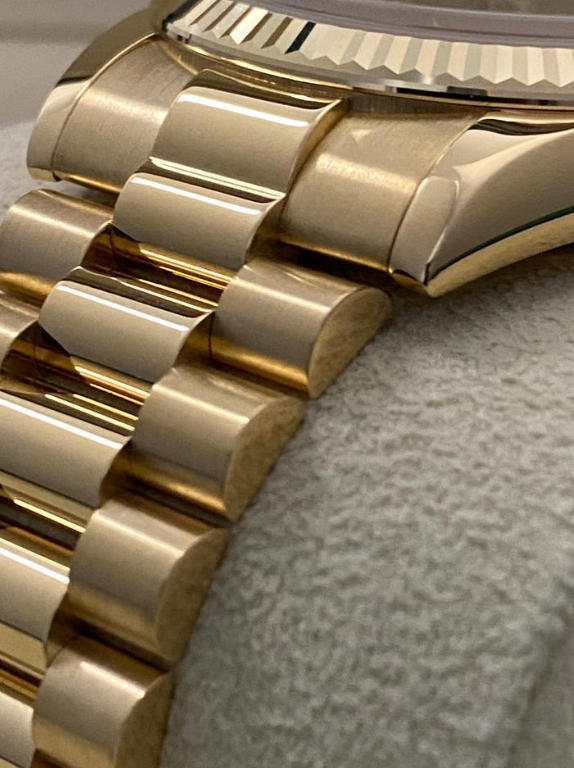
The President Bracelet Does More Than Complete the Look
People often talk about the President bracelet as though it were simply another Rolex bracelet option. On the Day-Date, it is much more important than that. Its rounded three-link construction changes the character of the whole watch.A good Day-Date design needs the bracelet to flow naturally from the case. If the centre links appear too wide, too sharp or too loosely finished, the watch can immediately lose the softer visual character associated with the original.This is one reason Rolex Day Date replica bracelet finishing deserves more attention than it usually receives. The clasp, end-link fit and transition between polished and brushed surfaces can matter just as much as the dial.
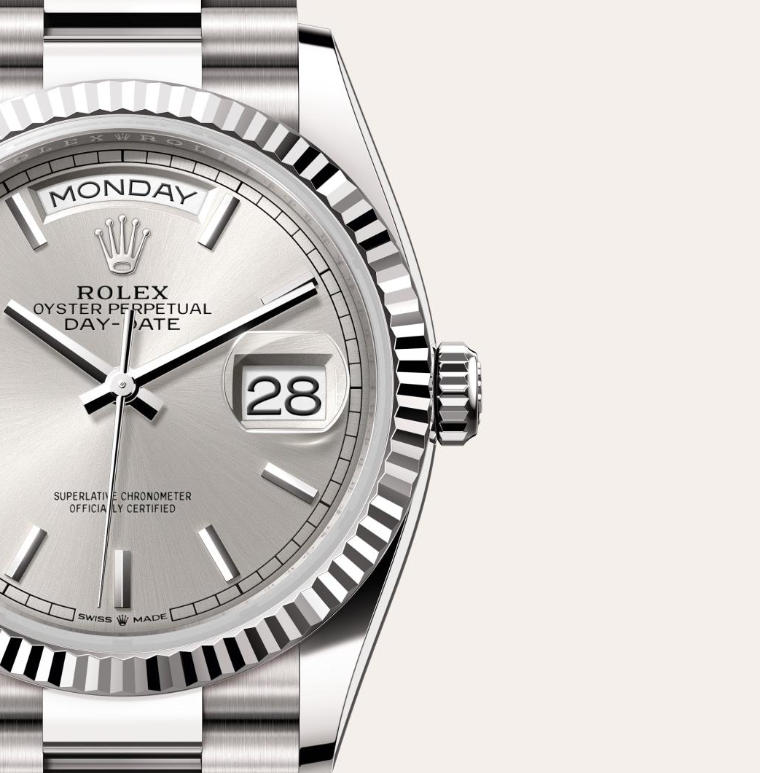
Why the 36mm Day-Date Still Looks Right
The classic Day-Date is closely associated with a 36mm case. By modern standards that can sound modest, particularly when so many sports watches now sit around 40mm or more, but the proportions work because the watch was never designed to rely on sheer size.The fluted bezel adds visual definition, while the day aperture stretches across the upper dial and makes the face appear broader than the case diameter suggests. The President bracelet also gives the watch more presence on the wrist.For someone comparing a 36mm Rolex Day Date replica in the UK, this is worth remembering. A larger case is not automatically a better-looking version. Case thickness, lug shape and bezel width often matter more than the number printed in the specifications.
The 1803 Era Still Defines the Vintage Day-Date
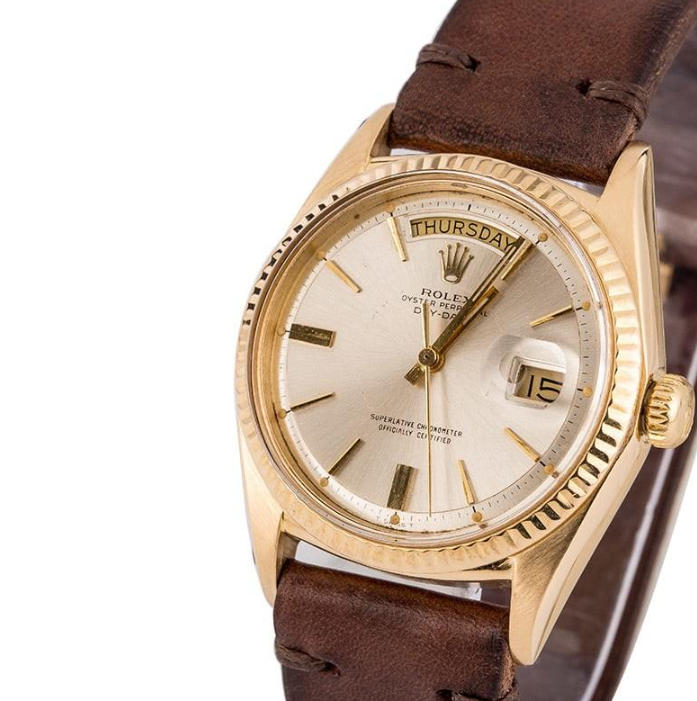
Among vintage references, the 1803 is particularly important because it established much of the Day-Date appearance collectors still associate with the model. It used an acrylic crystal and the characteristic pie-pan dial, while the President bracelet of the period had a noticeably lighter construction than current examples. :contentReference[oaicite:5]{index=5}These older watches have a softness that is easy to lose in reproduction. Modern machining tends to produce sharper surfaces, so a replica based on a vintage Day-Date can look too new if the bezel, dial furniture and case edges are overly crisp.The dial is another important point. Champagne dials may appear simple in photographs, but differences in colour temperature become obvious when the watch is seen in natural light. Vintage-style examples that are too yellow or overly metallic often miss the understated character of the original.
Quickset Movements Changed the Everyday Experience
Later generations introduced practical mechanical improvements. The 180XX series brought sapphire crystal and a quickset date, while the 182XX generation added the ability to adjust both the day and the date independently.These changes may sound minor compared with an entirely new complication, but they made the Day-Date much easier to live with. Anyone who rotates between several watches understands the difference immediately: resetting a stopped calendar watch is much less tedious when both displays can be advanced directly.For replica watches, this is an area where buyers need to separate appearance from function. A watch may reproduce the dial layout very closely while using a movement with a different setting sequence or calendar behaviour.That does not necessarily make it a poor watch, but it is something worth understanding before assuming that an externally accurate replica will work exactly like the genuine mechanism.
The Day-Date 40 Changed the Scale Without Losing the Identity
Rolex experimented with a larger Day-Date II before introducing the current 40mm generation. The Day-Date 40 brought the proportions closer to the traditional model while offering greater wrist presence and the newer calibre 3255 with a longer power reserve. Visually, the 40mm model is interesting because the design did not need to be reinvented. The day window, date magnifier, fluted bezel and President bracelet were already strong enough to survive the increase in size.For many UK buyers looking at replica versions, the decision between 36mm and 40mm is therefore less about which is objectively better and more about how the watch is intended to wear.A Rolex Day Date 40 replica with balanced case proportions can feel contemporary without becoming oversized, while the 36mm version retains more of the understated character associated with earlier generations.
Dial Details Are Where Differences Become Obvious
The Day-Date has appeared with an extraordinary variety of dials over the years, ranging from straightforward champagne and black layouts to stone, wood, diamond-set and brightly coloured variations. This variety makes the model attractive, but it also creates plenty of room for inconsistency in the replica market.Some of the details I would look at first are:
- the alignment and spacing of the day window;
- the size and magnification of the date;
- the shape and placement of the hour markers;
- the printing around the lower half of the dial;
- the relationship between the hands and the indices;
- the colour and surface texture of champagne or coloured dials.
The interesting thing is that none of these features is dramatic by itself. What matters is how they work together. That is often the difference between a watch that looks convincing at first glance and one that starts to feel wrong after a few minutes.
The Fluted Bezel Is Harder to Get Right Than It Looks
A Rolex fluted bezel seems like a simple repeating pattern, but its appearance changes dramatically depending on the depth, angle and polish of each flute.Too shallow and the bezel looks dull. Too sharp and it can appear harsh. The reflections should change as the wrist moves rather than producing one flat band of brightness.This is why Rolex Day Date fluted bezel accuracy is one of the more useful details when comparing different versions. It is also a good example of why photographs taken under strong studio lighting do not always tell the whole story.

Movement Claims Need a Little Caution
Replica listings often use language such as “Swiss movement”, “1:1 movement” or “clone calibre”. Those descriptions are not always applied consistently across sellers or manufacturers.Rather than judging a watch by the label alone, it makes more sense to look at practical questions: how smoothly the crown operates, how reliably the calendar changes, whether the movement can be serviced and whether replacement parts are realistically available.The genuine modern Day-Date uses Rolex’s calibre 3255, which introduced features including the Chronergy escapement and approximately 70 hours of power reserve. :contentReference[oaicite:9]{index=9}A replica movement should not automatically be assumed to provide the same architecture or long-term performance simply because its appearance or designation resembles the original.
Choosing Between Vintage and Modern Day-Date Styling
The Day-Date has changed enough over the decades to create two quite different personalities.Vintage-inspired watches tend to have softer cases, lighter bracelets, simpler dials and a quieter wrist presence. Current models are more substantial, more precisely finished and generally feel more contemporary.Neither approach is inherently better. Someone drawn to the 1803 is probably looking for something different from a person interested in a modern Day-Date 40.Our Rolex Replica Watches section covers other Rolex designs as well, which makes it easier to compare how the Day-Date differs from sportier models such as the Submariner, Yacht-Master and Oyster Perpetual.
What I Would Check Before Choosing a Day-Date Replica
If I were comparing two versions side by side, I would not start with claims about factory names or marketing grades. I would begin with the watch itself.
- Case proportions: check the lug shape, thickness and relationship between the bezel and middle case.
- Dial alignment: the day and date windows should sit naturally rather than looking squeezed into the dial.
- Bracelet construction: look closely at the end links, clasp and flexibility between links.
- Bezel finishing: the fluting should create clean, changing reflections instead of looking roughly cut.
- Calendar operation: confirm how the day and date are adjusted rather than assuming the movement behaves like the genuine calibre.
- Dial colour: champagne, green and darker dials can look very different under daylight compared with seller photography.
These are more useful checks than a broad promise such as “best quality” because they give you specific things to compare.
Why the Day-Date Still Works
The Day-Date has survived because Rolex never needed to turn it into something fundamentally different. The proportions have changed, movements have improved and the range of dials has expanded enormously, but the basic visual idea remains intact.That consistency also makes it one of the most revealing Rolex designs in the replica market. There are relatively few places for inaccurate proportions or weak finishing to hide.For UK readers interested in Rolex replicas, I think that is what makes the Day-Date worth examining. It is not simply about copying a well-known gold watch. A convincing version depends on getting a long list of quiet details right: the bracelet, the bezel, the calendar windows, the dial spacing and the way the entire watch sits on the wrist.When those elements work together, the Day-Date looks effortless. When they do not, even someone who cannot identify the exact problem will often sense that something is off.