
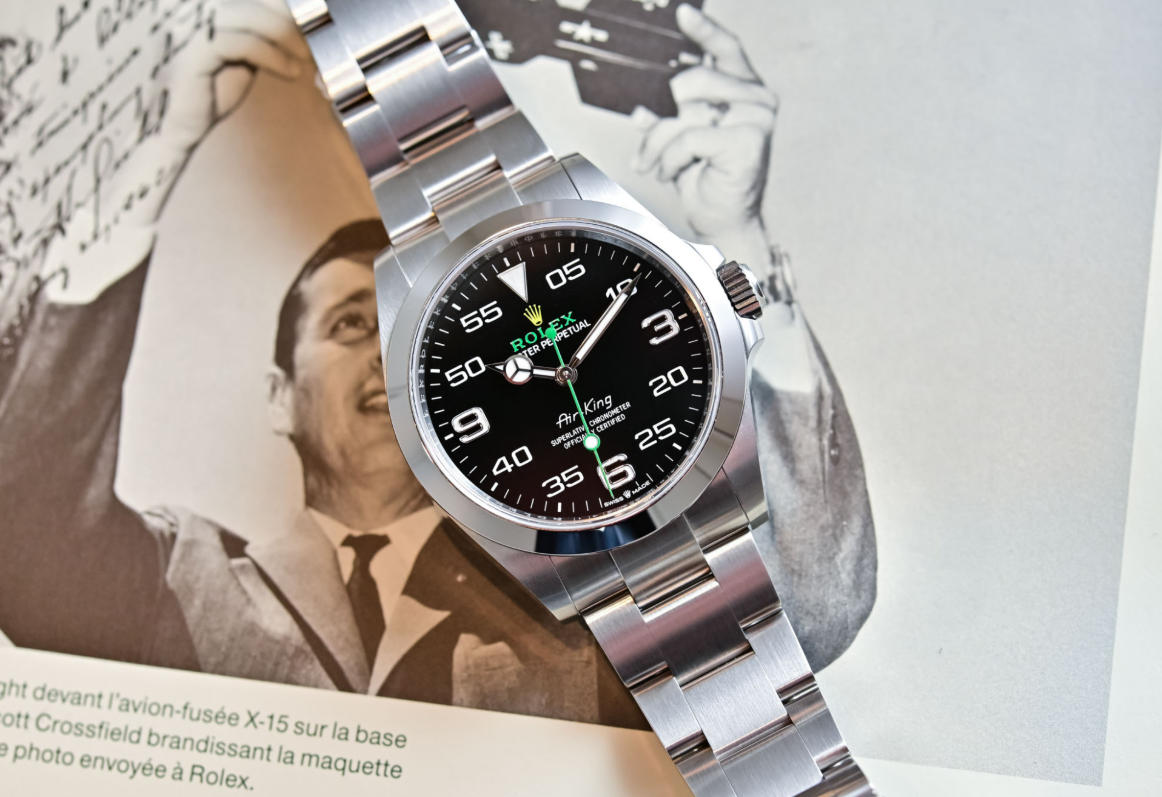
The Rolex Air King has never followed the easiest path through the catalogue. For long periods it was one of the quietest watches Rolex made, smaller and simpler than the sports models that attracted more attention. At other times it became one of the most unusual designs in the range. That long history is exactly what makes the Air King worth revisiting.
Early Air King references appeared in the years around the end of the Second World War, when Rolex used aviation themed names across several models. The Air King was the name that survived. It gradually settled into a straightforward Oyster watch with a clean dial, modest case size and automatic movement, creating an identity based more on restraint than on a single technical complication.
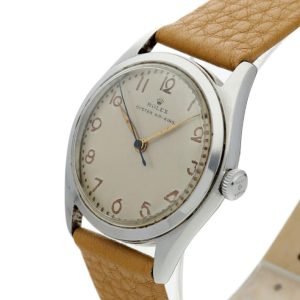
From early references to the long running 5500
The early hand wound references are very different from the watch most collectors picture today. Their dials, hands and cases reflect the experimental nature of Rolex production in the 1940s and 1950s. By the time references such as 6552 appeared, the Air King was moving towards the cleaner formula that would define it for decades.
The reference 5500 is the important turning point. Produced for many years, it established the compact 34mm proportions, simple baton markers and uncluttered dial that became closely associated with the model. Variations existed, but the broader character remained consistent: an Oyster case, an automatic movement and a design that sat between dress watch simplicity and everyday practicality.
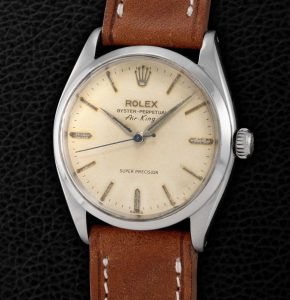
From a replica perspective, this era is useful because there is nowhere for poor proportions to hide. Rolex Air King 5500 replica details depend on case size, bezel width, marker shape and the relationship between the dial text and hands. A watch can use the right words on the dial and still look wrong if the case is too large or the printing sits too heavily.
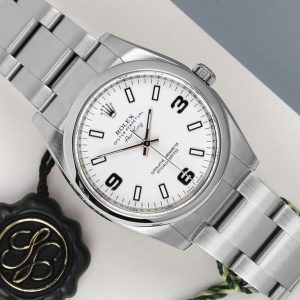
Later references 14000 and 14000M kept much of that familiar character while introducing more contemporary construction, including sapphire crystal and updated movements. The result still looked recognisably like an Air King, but with a cleaner, more modern finish.
When the Air King became bolder
The model changed direction with reference 116900. The case grew to 40mm and the dial became far more graphic, using large minute numerals, a green Rolex signature and a yellow coronet. It also adopted a stronger visual link with the Milgauss through its case architecture and antimagnetic construction.
That shift matters when comparing replica versions because the modern Air King is much less forgiving than the earlier minimalist references. The dial has more typography, more colour and more elements that can be misaligned. On a convincing example, modern Rolex Air King dial spacing needs to remain balanced even though the design itself is busy.
The later 126900 refined the concept again, improving the bracelet and case proportions while keeping the distinctive modern dial. It is a useful reminder that the Air King has never been a completely fixed design. Its history is a sequence of changes between restraint and experimentation.
Readers comparing current versions should therefore start by identifying the exact reference rather than treating every Air King as the same watch. The points worth checking on a 5500 are not the same as those on a 116900 or 126900. Case diameter, crown guards, bracelet construction, dial typography and movement behaviour all change with the generation.
Our Rolex Air King replica section looks at those model specific differences, while the ZZZX homepage covers the wider Rolex range. The strongest UK Rolex Air King replica comparisons are the ones that respect the history of the reference being copied rather than applying one generic checklist to every version.